
YVFWC Pipeline Programs Are Strengthening Rural Healthcare
Healthcare workforce shortages are a growing challenge nationwide. According to the Association of American Medical Colleges, by 2036, the U.S. could be short up to 86,000 physicians, with the greatest impact felt in primary care and rural communities. For more than a decade, Yakima Valley Farm Workers Clinic has worked to train the next generation of rural health care providers through our residency, fellowship, and apprenticeship programs. These programs not only prepare new providers for the challenges of rural health care, they also create a pipeline of new talent for our clinics.
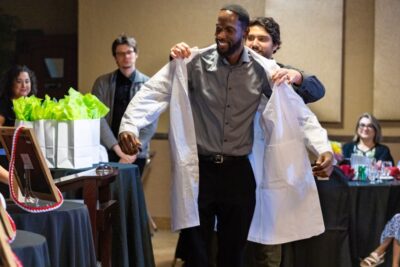
Dr. Kevin Mangat helps Dr. Haneef Muhammad put on his white coat during a party in June 2025 to congratulate those graduating from the Sollus Northwest Family Medicine Residency and welcome new residents to the program. Dr. Mangat will graduate from the program in June 2027, and Dr. Muhammad will graduate in June 2028.
We offer six different medical and dental residency programs, a maternal child health fellowship, and a medical assistant apprenticeship program. All are focused on providing the highest standards of training while delivering quality care to our rural, underserved communities.
Residency Programs: Hands-On Training in Community Care
Our residency programs provide hands-on clinical experience in medical, dental, and pharmacy fields. Participants work within a patient-centered medical home model and gain experience and a strong foundation in primary care while serving diverse populations across Washington and Oregon.
- Northwest Dental Residency (AEGD) – A one-year program to help refine and enhance general dentistry skills.
- NYU Langone Pediatric Dental Residency – A one-year program that prepares dentists with advanced, comprehensive skills across diverse patient populations.
- Sollus Northwest Family Medicine Residency – A community-based osteopathic residency emphasizing patient-centered care, interdisciplinary collaboration, and evidence-based practices.
- Sollus Advanced Practice Clinician Residency – Provides clinically complex training for family nurse practitioners committed to developing careers as primary care providers.
- Ambulatory Care Pharmacy Residency – An opportunity for pharmacists to practice at the top of their license, develop chronic disease management solutions, and collaborate with leadership to improve patient care systems.
- REACH – Residential Education in Advocacy and Child Health – Equips pediatric residents with the knowledge and experience to reduce health disparities among children.
Fellowships: Advanced Training for High-Need Areas
The Salud Rural Maternal Child Health Fellowship prepares family physicians for practice in rural or underserved communities with advanced training in low- and high-risk obstetrics, surgical obstetrical skills, management of neonatal complications, and advanced office gynecologic procedures.
Apprenticeships: Creating Pathways to Careers in Health Care
Our Medical Assistant Apprenticeship Program opens the door for individuals to begin a career in health care. The program provides paid on-the-job training, mentorship, and professional development.
While we take pride in training the future of rural health care, these programs also provide us with a pipeline of talented professionals who are familiar with our organization and the patients we serve. These providers are uniquely prepared to work in our clinics because they were trained in them and developed the relationships, cultural competence, and adaptability necessary to care for our patients.
“These programs are core to our mission and strategic goals; attracting and retaining top talent while also improving access to healthcare,” said Christy Trotter, YVFWC Chief Executive Officer.
To date, our residency, fellowship, and apprenticeship programs have trained approximately 273 health care professionals, and at least 88 of them have gone on to work in our clinics following graduation. This “grow our own” approach has strengthened our workforce and helped ensure rural communities have a growing pool of talented providers to serve their health care needs.