
Building Trust Through Conversations About Vaccines
For decades, vaccines have helped protect children, families, and communities from serious diseases. Yet in recent years, more patients have begun questioning the safety and effectiveness of vaccines. Healthcare providers are hearing concerns from a growing number of families who are navigating conflicting information from social media, websites, community influencers, friends, and family members. Questions that were once uncommon, such as whether children need every recommended vaccine or whether vaccines are truly safe, have become more frequent in exam rooms across the country.
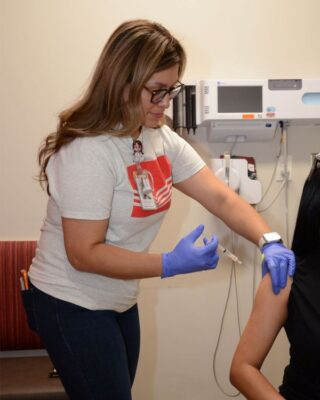
Blanca Soto-Lira prepares give a vaccination injection to a patient.
Dr. Jennifer Maxwell, a family medicine physician at West Valley Family Health & OB/GYN, says vaccine hesitancy has become more visible since the COVID-19 pandemic.
"I think culturally it's just become more mainstream as an idea," said Maxwell. "Because of that, there's just more pushback."
Rather than responding with confrontation or judgment, our providers are focusing on listening. In the past, vaccine discussions often began with a recommendation and a plan. Today, those conversations are more likely to begin with a question: What concerns do you have?
"We listen to the patients," said Lori Kelley, Chief Quality and Compliance Officer. "We don't just assume that our way is the only way or the right way. We like to practice shared decision-making."
That approach recognizes that parents and caregivers are trying to make the best decisions they can for their families. Providers take time to understand where concerns come from, answer questions, and help patients evaluate information using evidence-based sources. The goal is not to win an argument. The goal is to build trust and help patients make informed decisions.
Maxwell says those conversations often start with curiosity and empathy.
"My goal is not just to get that baby that one vaccine today," she said. "My goal is for that family and that baby to continue our relationship and receive health care."
Providers also work to make vaccine information easier to understand. Educational materials are available in multiple languages, and care teams use decision aids and plain-language explanations to help families understand both the risks of vaccine-preventable diseases and the benefits of immunization. Patients are encouraged to ask questions and discuss concerns openly.
"We all recognize that throwing facts doesn't necessarily change someone's mind, and usually it pushes them farther away," said Kelley. "But coming together and really having a shared, empathetic, open conversation can help a person have the tools they need to make a decision that mitigates risk to their child or to themselves."
Those conversations matter because vaccines do more than protect the person receiving them.
As children return to school this fall, they will spend hours each day in close contact with classmates, creating opportunities for illnesses